Pages

Sunday, September 30, 2012

Nuit Blanche 2012

We're having a tougher time enjoying Nuit Blanche these days since it has become a victim of its own success.  The more popular and presumably better projects are swarmed with people which result in wait times of sometimes over an hour.  Since this is longer than we have the patience to wait for a single event, we bypassed them and headed for the more accessible exhibits.  Possibly it was our own fault for not having more perseverance,  but the bottom line was that we were disappointed with what we saw.  There was not the wow factor of previous years.  The other issue could have been that we picked the financial/entertainment district which was easy to get to from our home, as opposed to the Queen West area where the projects seemed edgier and more interesting.  This stemmed from memories of previous years where we were trapped out in that area in the wee hours, unable to get onto any of the packed streetcars in order to return home.  So we can only blame ourselves and will try harder next year.

The presentation we enjoyed the most was the silent movies at TIFF accompanied by the live piano accompaniment.  We stayed for 3 very old films.  The first was a 1902 version of Jack and the Beanstock by Thomas Edison which looked like a filming of a stage play. The negative was so worn that we could see scratches on the film at one point.  There were no special effects to speak of, so the giant was just a very tall guy.  The second was a 1918 movie called "The Cook" starring Buster Keaton and Fatty Arbuckle as a waiter and a cook in a restaurant.  Their physical comedy transcends the need for dialogue.  A very funny recurring joke shows the cook producing all sorts of meals and drinks from the same huge vat, then tossing the dishes at the waiter who deftly catches them just as he walks into the kitchen. At the end, Fatty takes his hat and coat out of the vat to go home.  Fatty also stars in the next film called the "Reckless Romeo" who gets in trouble when he flirts with other women and is caught by his wife.  All 3 clips can be found on YouTube.

Speaking of YouTube, another showing at TIFF focused on videos from YouTube.  The show was really lame, from the two young hosts trying to be hip, to the quiz show and sing-along components.  The only mildly amusing part was when they showed a trailer of Mrs Doubtfire re-cut as a horror movie.  The third theatre was showing 101 zombie killings from various bad zombie movies.  The last feature at TIFF was a video of a lighthouse floating in the middle of the English Channel that made me seasick to watch.

A few other minor highlights included the Green Invaders that looked like primitive, early video game characters that either raised their hands in a smile, or lowered them in a frown.  It did not seem like any interaction from the crowd was controlling them as they randomly appeared in different numbers and positions.  Skylum was a giant floating blimp that had lights which responded to movements underneath it.  There was a huge lineup to get into the Commerce Court for Water Will Be There.  We didn't want to wait for this so we couldn't see what was happening inside.  But walking by the outside was entertaining as we saw the shadows of the participants walk by giant screens showing water and nature scenes.  They were hamming it up by making gestures and shadow puppets so possibly they knew they were being watched.

Most of the other exhibits that we saw consisted of videos and sculptures that we didn't find very interesting.  There was a tower made of old computer parts, a lighthouse with a very faint beacon in Brookfield place that was drastically outclassed by its beautiful surroundings and a video that showed plant growth sped up with stop motion photography.  In a glass case in front of First Canadian Place, some kid was solving a Rubic's Cube but after watching for a few minutes, we didn't think he was very particularly fast at it so we didn't see the point.

Actually three of the most memorable attractions for us were not even officially part of Nuit Blanche.  First was the polenta coated fish taco with sweet slaw, avocado cream, peach salsa and cilantro I got from the Gourmet Bitches food truck.  We were amused by the lady in front of us who didn't want to order the "Bitchin' Fries" by name because she didn't want to swear.  The joint that was the most hopping was the Virgin Records DJ booth which was blasting music while the crowd danced in the streets.  And finally an impromptu video game that seemed like Tetris on a pirate ship, complete with cool sound effects was being broadcast above the SEARS logo at the Eaton Centre.  It was powered by some random guy and his laptop but it was so much fun to watch.

We've pledged to do better research next year and maybe even wait in line once or twice in search of a more satisfying Nuit Blanche experience.

Thursday, September 27, 2012

Free Concerts 2012 at Richard Bradshaw Amphitheatre

As autumn approaches, another season of free concerts in the Richard Bradshaw Amphitheatre at the Four Seasons for the Performing Arts has begun.  One hour concerts at noon on Tuesdays and Thursdays (and sometimes Wednesdays noon or 5:30pm) feature either piano, jazz, dance, vocal, chamber music or world music performances.

We watched the Dave Young Quartet play a jazz set which included songs by Oscar Peterson (Wheatland), Rogers and Hart (Falling in Love with Love), and some Glenn Gould Bach-inspired music as a tribute to what would have been Gould's 80th birthday.

The quartet was led unusually by the bass player, Dave Young, with Kevin Turcotte on trumpet, Robi Botos on piano and his brother Frank Botos on drums.  Unlike the role of the bass player in most bands, Dave Young carried the melody on many of the songs. He even played some tunes using his bow, which I've never seen in jazz before.  My favourite songs featured Turcotte playing a muted trumpet.  I really like that sound.

For the first time in many years, I was able to get a seat for one of these free concerts.  When I first started going about 4 years ago, you could show up to the noon concert at 11:45am and still get a seat.  Within a few years, the popularity of these concerts grew and even by 11:30am, it was standing room only, with the doors closing due to capacity shortly after.  I've always wondered how early you now had to come to get one of the 100 spots on the amphitheatre style seating that faced the concert.  This year since I was not working, I showed up really early and got my answer.  You need to be in line by 11:10am or forget about it.  Although it was great to finally be able to watch the concert from the proper vantage point, it was hard on my lower back to sit on the steps without a back rest.

There was a row of chairs on the floor above the concert, situated behind the performers.  After a while, I almost wished I was sitting there since at least they had back support.  This is also where wheelchairs could be positioned.  It was amusing to watch the row of people that sat above.  I was surprised to see a number of them reading, napping or even doing a crossword puzzle during the performance.  I guess they were multitasking while enjoying the music.


Wednesday, September 26, 2012

TIFF 2012

Thanks to our good friend Peter who is a patrons member at TIFF, Rich and I were given the chance to attend a couple of pre-festival events that each involved a cocktail reception on the rooftop of the Bell Lightbox.  Needless to say, the views were spectacular and great hors d'oeuvres were provided by Oliver&Bonacini who own the restaurants at this venue.

The first event was a sneak peek screening of the movie Arbitrage starring Richard Gere and Susan Sarandon. A corporate thriller about a hedge fund magnate who is in over his head on several fronts, this movie was not showing at TIFF and had not been released to the theatres yet, so we really did get an early look.  The second event was even more exciting, since it had all the programmers in the festival reveal their picks for favourite movies within their programmes.  Each one provided the hot pick that had the most buzz, a hidden gem and their personal favourite.  This was valuable information that was provided the night before we had to make our movie picks and resulted in our making a few last minute adjustments to our choices.

This was the first year that we were not working during TIFF.  We celebrated by watching a slew of movies - the total was somewhere around 28+, averaging 2-3 per day for the 11 day run.  With the luxury of time and a wide open schedule, we were able to pick a good mix of genres, countries, a few with big stars, and even a selection of documentaries and one short film series.  We saw comedies, romantic comedies, dramas, thrillers, action, and even a horror-comedy film (which I was peer-pressured into watching).  We watched movies from Canada, USA, Ireland, Hong Kong, Japan, Korea, Germany, France, Lebanon, Sweden, Bulgaria, Spain, Australia, UK, and Senegal.  That many movies will always range in quality and entertainment factor, which to some degree depends on personal taste.  While there were movies we loved and some that were just OK, there were only 3 that we regretted watching, which is a pretty good average.

There were too many movies to describe them all, so I'll just concentrate on my highlights and "low-lights".  We had four favourites which were The Sapphires, Thieves, Key of Life and The Attack. 

The Sapphires is loosely based on the true story of four Australian Aboriginal girls who formed a singing group and went to Vietnam to entertain the troops.  This movie had everything including comedic moments, great 60s music, a budding romance, serious themes regarding Aboriginal separation where children were taken from their families and tension that arose from the dangers of being in the middle of the Vietnam war.

Thieves is an action-packed, fun-filled jewel heist caper that felt like Ocean's Eleven on speed.  Two rival gangs, one Korean and one Chinese, band together to rob a casino that is storing a magnificent gem.  Many of the members have their own motivations and hidden agendas as double-crosses pile up one on top of another.  In addition to the expected car chases, there is an amazing high-wire chase scene where the protagonists swing from building to building and floor to floor.

Key of Life is a hilarious screwball comedy about Sakurai, a down-on-his-luck actor, who switches places with Kondo, a wealthy man who slips on a bar of soap in a bathhouse and develops amnesia.  Sakurai soon discovers that his new identity is that of a professional assassin, while Kondo embraces his presumed life as a struggling actor.  Further complicating matters is Kanae, a highly organized and motivated female executive who has scheduled her wedding date and now just needs to find the candidate to play the groom. 

The Attack is a powerful drama whose back-story is as interesting as its plot.  The movie is about an Arab surgeon who lives in Israel, and has integrated and is accepted by the Israeli people.  His world is turned upside down when he learns that his beloved wife has just set off a suicide bomb in a busy restaurant, killing a bunch of children at a birthday party in the process.  The rest of the movie deals with him trying to understand why she did it and who influenced her.  At the Q&A, the Lebanese director explained that it was illegal for himself and his actors to shoot the movie in Israel and Palestine.  He had to appeal to the Lebanese government and the leader of Hezbollah to get permission.

Every year, we try to watch a Midnight Madness movie.  Starting at 11:59pm, these movies often fall in the horror genre, or are action thrillers that are much darker and more violent. The crowds at Midnight Madness are wild, rowdy and boisterous and often clap, cheer or shout out in the middle of the movie.


This year the big buzz movie was Seven Psychopaths, which boasted an all-star cast including Colin Farrell, Sam Rockwell, Woody Harrelson, Christopher Walken, Abbie Cornish, Tom Wait and Olga Kurylenko.  Marty (Farrell) is a writer who needs inspiration for his book called Seven Psychopaths so his friend Billy (Rockwell) puts an ad in the paper to try to find some for him to meet.  In the meantime, Billy is in cahoots with Hans (Walken) to steal dogs and then return them for the reward money.  Problems ensue when they accidentally steal the dog of a vicious mobster (Harrelson).  This movie was very funny in the beginning but drags a bit towards the end.

The best short film that we saw was called "Canoejacked" about two convicts who escape into the wilderness while being chased by a law enforcer.  They spot a canoe and decide to steal it for their getaway, but when the owner, a nudist catches them, they take him along for the ride.  My new favourite word is the coined phrase from the movie - canoe-dist .. or is it can-nudist?

We did not like The Walls of Dakar about the graffiti culture in Senegal.  The movie was so boring and unstructured that when I woke up part way through the film, more than half the original audience had left.  This was extra disappointing since it was one of the top picks from the programmer.  I guess we need to take those recommendations with a grain of salt. 

After watching The Color of the Chameleon, we felt that we had fulfilled TIFF's slogan for this year, which was .. "From OMG to WTF".  We definitely experienced the latter after walking out of this film, scratching our heads and wondering what the heck that was all about.

Word on the Street 2012

This year I attended Word on the Street for the first time.  It is a festival that celebrates books, authors, publishers and readers, bringing all these elements together on one day.  It is held at Queen's Park and features stalls representing major and minor Canadian publishers of books, magazines, and newspapers, as well as authors promoting their latest works through book signings and readings.  Larger tents of various themes had events scheduled throughout the day.

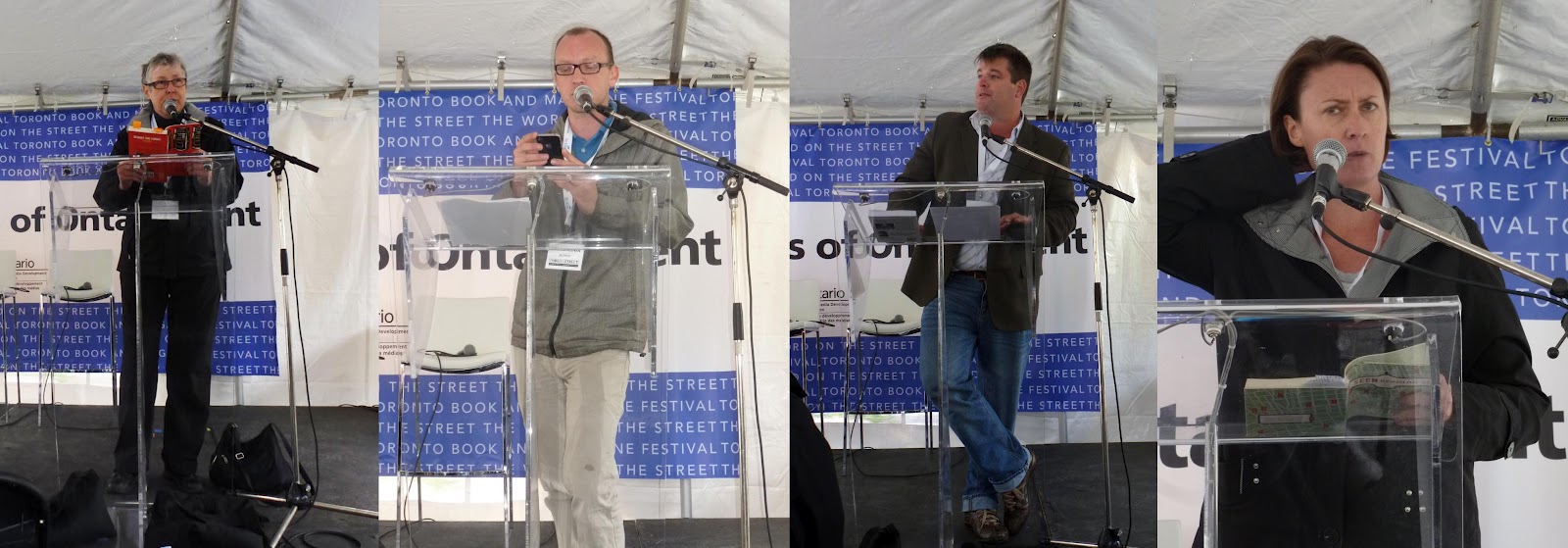
At the "Vibrant Voices of Ontario" tent which focused on local authors and stories, we attended our first event called "We Love Toronto: Books Inspired by the City".   Four authors, whose works of fiction or non fiction each used Toronto as the setting, read excerpts from their books and then answered questions.

"Oranges and Lemons" by Liz Bugg follows lesbian detective Cali Barrow on a new case.  Her home and office are set in the Kensington Market neighbourhood, while a boxing scene is based on the Toronto Newsgirls Boxing Club.  The author read with a melodramatic tone that perhaps surpassed the actual words on the page, which I found a bit off-putting and distracted me from the narrative.

Edward Keenan, editor of GRID magazine, wrote the soon to be published "Some Great Idea: Good Neighbourhoods, Crazy Politics and the Invention of Toronto".  He asked the audience whether they would rather hear an excerpt about how great Toronto is, or one about Mayor Rob Ford.  Of course, we went for the potentially more scandalous topic.  Rather than dwelling on Ford's recent slip-ups, Keenan's excerpt dealt with his time traveling around Toronto with Rob Ford when he was still a councilor.  Ford took pride in seeking out his constituents, even at their homes, in an attempt to solve their problems.  The reading was followed by an interesting discussion about how the tactics that endeared Ford to his constituents as a councilor did not work in the role of the mayor.   Because Keenan had not previously intended to discuss this particular topic, he had not printed out the section and had to read the text from his smart phone.


"Hope and Heartbreak in Toronto" by Peter Robinson sounded like a romance novel until we heard the subtitle: Life as a Maple Leafs Fan.  He has a knack of spinning the tale of his personal experiences as he describes his devotion to the Maple Leafs despite their decades long losing slump.  He compares how the Leafs make him feel to a sadomasochistic scene he witnessed looking into the window of a brothel in Hanover, Germany. 

Julie Wilson has an interesting premise for her book called "Seen Reading".  When she sits on Toronto transit, she watches other people reading, taking note of the reader, the book and the page number being read.  From each interaction, she is inspired to write a small snippet of fiction, no more than several paragraphs long.  The quote she liked to use to describe the readers she witnesses is "If I am a voyeur, then you are all exhibitionists".

At the Scotiabank Giller Prize Bestsellers tent, there was a huge crowd gathered to hear Gail Vaz-Oxlade, the star of the TV show "Til Debt Do Us Part" talk about her best selling book "Debt Free Forever".  We did not stumble upon this talk in time for the book discussion but did make it to hear the tail end of the Q&A.  Gail sounds just like she does on TV.  In her booming, sassy voice, she gives motivational, no-nonsense straight talk about debt, finances, mortgage.  There was a hilarious discussion about the high cost of divorce (she's split up 3 times and declared no more!) that brought to mind the lyrics from the old song - "you better keep her i think it's cheaper, then makin' whoopee".

At the Penguin Pavilion tent, promoting books published by Penguin Books, we listened to celebrity chef Mark McEwan and food writer Jacob Richler (son of Mordecai) be interviewed by the owner of the Cookbook Store.  They talked about past and current restaurant trends, what and how they cooked in their personal time, and their thoughts on banning items such as fois gras.  Jacob's book title "My Canada Includes Fois Gras" says it all.

The Scribendi Workshop Marquee Tent focused on talks and workshops to help the fledgling writer.  I just made it to the end of one of the most entertaining, useful or mortifying workshops, depending on your point of view.  Writers were given the opportunity to anonymously submit a 1 minute sample of their draft work.  This would be evaluated by professionals including a published novelist who teaches at the Humber School for Writing and a publisher.  The snippets were read aloud by the host of the session while the the judges took notes and occasionally stopped the reading in mid sentence (think American Idol tryouts) indicating they had heard enough.  Their constructive criticism pulled no punches.  Once they even burst out laughing at a sentence that was obviously not meant to be funny, which caused the rest of the audience to laugh, and probably made the author secretly cringe.  The writeup on the event did say you need a thick skin to participate.

Subsequent lectures dealt with tips on how to get published as well as details about self publishing and publishing in electronic formats (e-books) as opposed to traditional paper format (p-books).  Much was stressed about how the publishing part was just half the battle while self promotion of your book was equally if not more important.  The use of social media such as Facebook, Blogging, Twitter now seems to be a major component of book promotions.

Back at the Scotiabank Giller Prize Bestsellers Stage, noted environmentalist David Suzuki and economist Jeff Rubin discussed the interconnections between ecology and economy as part of their 10 city Canadian "Ecotour".  Rubin theorized that continually rising oil prices will lead to slower economic growth, which could actually result in fewer carbon emissions.  It may also lead to a change in our way of living.  Since oil is the main, if not only fuel used in transportation, the costs of importing and exporting could grow to an unsustainable level.  This could result in a less global economy where we once more rely on local manufacturing and stay closer to home, both in terms of commuting to work and to travel. 

There were many other interesting talks and unfortunately we could not get to more of them since they were all scheduled at the same time.  Looking forward to next year.

Thursday, August 30, 2012

TIFF 2012 : Advanced Screenings

 This year I was fortunate enough to have the opportunity to watch some advanced screenings of movies prior to the start of the Toronto Film Festival.  As with any eclectic set of films, I found some were fun and entertaining, while others were more thought provoking, and unfortunately, one was just downright aimless and boring.

My favourite movie of this set was the Irish crime comedy/thriller called “Jump” involving a heist, an attempted suicide, a car accident and small-time hoodlums running around, all happening on New Years Eve.  This action packed flick hooks you from the opening scene and then takes you on a wild ride, keeping you guessing all along the way. Multiple parallel plot lines intersect with each other, but after a while you realize that at least one of them is a flashback.  As the scenes play and then play again from different viewpoints, things that seemed confusing or mysterious the first time suddenly make sense and each payoff feels really satisfying.  The pulsing soundtrack and fast-paced action ratchets up the tension and then releases it with spurts of comic relief.    

Another fun movie was the documentary “Secret Disco Revolution”, which used 3 actors dressed like members of the old TV show “The Mod Squad” to portray the “masterminds” behind the promotion and evolution of disco.  This cheesy and humorous plot device gave the documentary some structure in presenting the history of disco . Interviews with DJs, producers and former disco stars such as The Village People, Anita Pointer of the Pointer Sisters, Gloria Gaynor, Thelma Houston, etc. were spliced with video clips of archival live performances and scenes from discotheques.  One of the main arguments of the movie was that disco aided the cultural emancipation of women, blacks and gays.  Much time was spent discussing how Donna Summer’s moaning rendition of “Love to Love You” represented a 12 minute female orgasm.

The movie that made the most impact on me (although I’m not sure I would have called it entertaining) is Janeane from Des Moines.  A strange cross between documentary/mockumentary and scripted drama, it follows ultra conservative, religious housewife “Janine”, whose life is falling apart when her husband loses his job with its company health care plan and she discovers she has cancer.  She attends the Republican primaries, trying to question each of the candidates on their alternative plan for providing health care to the poor since each of them pledge to eliminate Obamacare.  It is during these sessions that the line between documentary and drama blurs.  Janeane is captured on film actually interacting with each candidate including Mitt Romney, Rick Santorum and Michelle Bachmann who actually converses with her at length over coffee.  Janine begins to question the party platforms when it becomes clear that none of the candidates offer her any real health care options.  I wonder how the candidates feel to realize they were set up and now star in a subversive movie.

 The Canadian movie I Declare War depicts two groups of children using very realistic war game tactics to play “Capture the Flag” in a remote woodland. The weapons and battles are seen from the point of view of the children’s imaginations.   Plastic toys turn into machine guns and assault rifles, and the sounds of gunfire and bomb explosions are deafeningly loud.  Amidst of all this, relationships are explored as mutiny, flaunting of game rules, friendships, alliances, trust and betrayal are all in play.  Even though you can clearly see that these are just children engaged in make-believe, you get caught up in the intensity of the game.  The child actors were all very talented and versatile, showing a wide range of emotions and vulnerabilities underneath postured toughness.  This movie is Lord of the Flies meets Patton.

 Another Canadian film called Blackbird revolves around a teenaged Goth-dressed outcast in a small town who is falsely accused of planning a mass school shooting.  This was an intense movie that was admirable for the plot and acting but was not exactly fun to watch.  I came out feeling anxious and a bit depressed.

Finally the documentary London – The Modern Babylon was the movie I found to be unstructured and boring.  After watching the random archival footage about London’s history stream for over two hours, I didn’t really comprehend what was the central theme or point of the movie.  As a postscript, the director made a comment during the showing of the credits that confirmed the lack of editing was intentional.  You can tell I am not enjoying a movie when I wear out the battery of my Timex Indiglo watch trying to see how much longer until the end…

Thursday, July 19, 2012

Play Me, I'm Yours Pianos

First we had moose, then snowmen and now pianos have been scattered around Toronto.  There are 41 in total, each decorated by local artists to represent one of the countries participating in the 2015 Pan Am Games.  On each piano is painted the words "Play Me, I'm Yours", encouraging the public to interact with and actually sit down and play the pianos.

As we wandered around looking for pianos, we came across several where people were in the process of playing them.  We passed by the colourful piano in Berczy Park, just missing an impromptu concert by an 8 year old prodigy.  Apparently he gave quite the performance and a crowd gathered to listen and clap before his mother dragged him away.  Hearing this made it too embarrassing for me to try the only thing I know how to play anymore, which is "Heart and Soul".

These pianos are a great way to generate awareness and interest for the Pan Am Games.  We'll have to keep our eyes open for more of them.  I found a map of their locations here: http://www.globaltoronto.com/pan+am+games+set+to+spread+music+across+toronto/6442674054/story.html

Monday, July 16, 2012

Fringe Festival 2012

Although we watched 14 shows at this year's Fringe Festival, they did not have the wow factor of last year.  There was no clear equivalent to last year's Kim Convenience, which went on to a professional run as part of Soulpepper's 2012 season.  We did see a few shows that we really enjoyed:

Our favourite show was a hilarious comedy called Porn Star, about a mousey librarian named Esther who finds out she has been nominated for an amateur porn award because of a sex tape that her ex-boyfriend had secretly filmed and posted online.  Deciding to spice up her mundane life, she decides to go to the ceremony and en route meets and falls for a lesbian sex advice columnist.  This causes issues with her mother who is an ultra-conservative evangelist with political ties to Sarah Palin.  A final subplot about Esther's sister, who committed suicide at 14 but is now trying to escape hell because she doesn't like it there, just adds to the fun.

Honour Killings was a dramatic portrayal of the events and motivations that might have led to the real life drowning murders of three sisters and their stepmother from Montreal.  Their parents and brother were convicted of the killings, meant to redeem the honour of the family against the sisters' perceived sins.  The girls were portrayed as beautiful, spirited, intelligent young women who were killed for acting like typical North American teenagers, including "wearing revealing clothing and having secret boyfriends".  The play paints a very plausible scenario of what might have happened in this family with conversations and interactions following very closely to what was reviewed in the trials of the accused.

Bad Connections is a tour-de-force performance by actor Paul Costentino, who stood on an empty stage except for a chair and performed all the roles in a play about interconnections. Using only changes to his voice, posture and rubber face, he plays 8 different characters including a black pregnant woman, an angry Italian man, a four year old boy, an old man in the hospital, a middle aged Jewish woman, a sad cardiologist, a gay yoga instructor, and a wisdom-spouting guru.  In the first act, each character is introduced through a series of monologues.  By the second act, the characters start to interact and you begin to see how they are all interconnected.  It is amazing to see Costentino basically carry on conversations with himself, quickly switching back and forth from one character to another.

Help Yourself is a fast-paced, dark comedy featuring Donny, the slick, quick-talking consultant who helps his clients justify whatever illegal or amoral act that they wish to commit.  The nervous and hapless Ted wanders into Donny's penthouse apartment "office, with a dilemma. Ted wants to kill his cheating wife but is also afraid and horrified by the idea.  The balance of the play is spent with Donny cajoling, haranguing, and plying Ted with liquor in an effort to convince him that this would be OK.  A seemingly inconsequential subplot showing flashback conversations between Donny and his girlfriend culminates in a disappointingly abrupt and predictable "twist" ending.

We were entertained by the next set of plays but not totally won over by then.  The solo actor in Charlie the Hockey Story played his guitar and told stories around the real life 1932-47 hockey career of his uncle Charlie Sands.  He spun a good tale but the relentless urging for the audience to sing along to his songs became a bit annoying.

Sharilyn Johnson stars in Fake News Fan Girl, recounting a the true and personal tale of her adulation and borderline stalking of "Fake News" stars Stephen Colbert and John Stewart.  She delivers her story with humour, passion and vulnerability.

The musical 21 days was a fantasy based on the premise that Julie has a rare disease that only allows her to experience and live through 21 extraordinary days.  She needs to decide whether she wants a long life of mediocre days or rather choose to live life to the fullest and enjoy the 21 great ones.

Unfortunately this year, we saw quite a few shows this year that we didn't really care for.  We thought the musicals One in a Million and How I Lost One Pound  were silly and forgettable, while Breaking Velocity was overly self indulgent. Samkon and Francis go Swimming (Part I) started out with an amusing premise but then ended abruptly.. we should have been forewarned by the "Part I" in the title.  I fell asleep during Medicine - enough said?    The final two plays were gimmicky but didn't quite work out.  Spychasers was based on a novel by the same author who wrote "The 39 steps", so it sounded really promising.  All the actors in the play were from a seniors theatre group and some of the "acting" was suspect.  However there was great staging that was reminiscent of a production of The 39 Steps that we saw once off Broadway.  The only thing I remember about The Ballad of Randy and Evi Quaid was that after the show, we read in the paper that Randy Quaid was actually in the audience on the night that we saw it.

We go to the Fringe knowing it is hit and miss in terms of what shows we'll like, so better luck next year.

Friday, June 01, 2012

Talk With War Horse Author Michael Murpurgo

After thoroughly enjoying the play War Horse, I was thrilled to win tickets to hear the author Michael Morpurgo speak and read excerpts from the book.  (By the way, if you aren't registered for the Mirvish eStage newsletter, it offers frequent show discount offers and contests).


  Morpurgo is a gifted speaker and a natural story teller.  During the Q&A session, he was able to take even the most mundane questions and fill his answers with amusing quips and anecdotes.  A testament to his prowess lay in the fact that he kept an audience littered with small children entertained, without the presence of any puppets or visual aids.  When I first saw all those children in attendance, I worried, wondering if they realized that they would spend the evening not watching the show, but listening to some old guy talk.  However they seemed enthralled by Morpurgo and eagerly asked questions of him afterwards.

Morpurgo described how he first came up with the idea of writing War Horse.   He met a WWI veteran who described being placed in the cavalry at 17 without knowing anything about horses.  Scared and lonely, his horse became his best friend to whom he confided how frightened he was and how much he wanted to go home.  Michael thought there was a good story here but was looking for a unique perspective so that he didn’t end up writing another Black Beauty.  He found it when he witnessed a young boy who never spoke to humans due to some trauma, in deep conversation with a horse on Morpugo’s farm.  And the horse appeared to be listening attentively!  This confirmed his idea of writing from the horse's perspective.  

War Horse the book tells the story through the eyes of a thoroughbred colt named Joey, who was purchased at auction by a drunken farmer, lovingly raised by the farmer’s son Albert, but then sold by the farmer to the British cavalry during WWI.  Joey struggles to survive the war, moving from owner to owner on both the British and German sides, including Captain James Nicholls, young Emilie and German soldier Friedrich before finding his way back to his beloved Albert.

Apparently the book did not sell well in its original publishing and it was just by chance that 20 years later, a director looking for a vehicle to stage a play with handspring puppets was made aware of the book by his mother ("I just read a book about a horse by a man with an unpronounceable name").  The rest is history...

Morpurgo proceeded to read passages from War Horse, his voice animated and dynamic. Immediately you are able to identify with Joey and become engrossed in his travails.  Melanie Doane, the violinist and singer from the play, provided musical accompaniment, which added emotional resonance to the reading. 

I've since read the book War Horse and enjoyed it immensely.  While the play keeps most of the important plot points from the book, there are some significant differences.  The play could not easily portray the story from Joey's point of view and so it becomes more of a traditional story between a boy and his horse, focusing more on Albert's journey to reunite with Joey (typical love story plot of boy meets horse, boy loses horse, boy gets horse back).  Having experienced both, I think they are each excellent in their own ways although I prefer the ending of the book which I found to be more powerful and moving.

During the Q&A, Morpurgo revealed that Joey was named after the foal of the horse that the young “mute” boy on his farm was talking to.  In describing the critically lauded War Horse play versus the not so acclaimed Steven Spielberg movie, Morpurgo tactfully summarized that while the movie followed the plot of the book more closely, the play captured the heart and the spirit of it. In describing the effectiveness of the handspring puppets in the play, he tells of how the actor who portrays Friedrich laments that although he acts his heart out, no one cries for him when his character is killed.  They don't care about the humans .. all they care about are the bloody horses … the puppets!

The author’s note in the book describes a painting of Joey that hangs in the village hall with the dedication “Joey – painted by Captain James Nicholls, autumn 1914”.  A busload of Canadians visited his home town and were anxious to see the painting.  To not disillusion them, they were told it was out being cleaned.  “Don’t they realize it’s a book!?!” Morpurgo humorously roared.  So he got the props department from the movie to make him a painting with that inscription and hung it in the village hall, so that “no more Canadians would be disappointed”.

It was great fun listening to Michael Morpurgo speak and I’m glad it prompted me to read the book.  I hope the success of the play inspires more people to do so as it really is a wonderful book.  I’m not sure I want to watch the movie though.

Wednesday, May 30, 2012

AGO - Zhang Huan Ash Paintings and Memory Doors


I'm ashamed to say that until recently, I had never heard of world reknowned Chinese artist Zhang Huan who is known for his performance art, sculptures and photography.  Now suddenly, his presence is felt all over downtown Toronto, as he unveiled his new sculpture that will grace the front of the Shangri-La Hotel at University Ave and Adelaide St, has an art exhibition at the Art Gallery of Ontario and was designer and director for the opera "Semele" which played at the Four Seasons Centre for Performing Arts. 

The giant permanent stainless steel sculpture is named "Rising" and looks like a morph between a dragon and tree branches or roots, with peace doves perched throughout.  Huan said that his piece "advocates ... harmonious relationship between humans and nature".  What a wonderful addition to our city!

Zhang Huan's show at the AGO is awe inspiring and in some ways, I was more impressed with it than I was with the  Picasso exhibition which I saw on the same day.  Huan's floor to ceiling ash paintings seem to involve an excruiating amount of prep work.  He takes the ash remnants left by worshippers burning incense at temples around China, sorts them into shades of colour (white, beige, grey, black, ..), then uses that ash to create these amazing paintings that are so lifelike and full of depth, texture and even simulated light and shadows.

Airplane enthusiast Rich got all up in arms about the "curatorial error" he spotted in the description of how realistic the painting of the airplanes looked.  It talked about almost being able to hear the whirl of the propellers and smell the fumes from the diesel engines.  He scoffed that this would be quite a trick since these are portrayals of MIG jets which neither have propellers nor use diesel engines.   I think Rich is missing the forest for the trees, but Rich says the devil is in the details.  We've agreed to disagree.

One painting which spanned an entire wall was of many workers in a field with mountains in the background.  The amount of detail depicted in this painting including the clothing and hats on the tiny little people was just incredible.  I spent a long time staring at this particular piece. 

Huan also displayed "Memory Doors" which were antiquated wooden doors from country homes on which he pasted old black and white photos representing military, labour or daily life of the Chinese.  He then had carvers chip away parts of the door to replicate the images on the photos.  The 3-dimensional effects of the piece are often accentuated by rivets or bolts originally found on the doors.

I didn't hear much about the opera which he directed but I assume it was just as magnificent as the rest of Huan's work.  Now that I am aware of him, I will continue to look out for more of his art.  I would love to see a performance piece one day.

Tuesday, May 29, 2012

AGO: Masterpieces from the Musée National Picasso

Picasso, Masterpieces from the Musée National Picasso in Paris is the AGO's blockbuster show for 2012.  We're delighted to see this since we've been trying to go to that Picasso museum for our past two trips to Paris but it has been closed each time.  While there have been many different exhibitions of Picasso's work, this one is unique in that it represents the pieces that the artist kept for his own private collection.  Presumably this implies that this body of work held special meaning for him, so it was fun to interpret what that might  be.

Picasso is arguably one of the most prolific as well as eclectic artists that we've ever known.  The number of different painting styles that he attempted are as vast as they are varied in nature.  The exhibition is laid out to follow Picasso's painting periods or styles chronologically, traversing through the Blue and Rose periods, African influences, Cubism, Classicism, Surrealism, War Years, and his last works prior to his death.


Through the years Picasso used the women in his life, from lovers to wives, as inspiration for his art.  The exhibition showed that as he moved through his different periods, he represented his current muse in his "style-de-jour".  His first wife Olga Khokhlova luckily landed in his Classicism period and therefore she was portrayed in a realistic natural form.  Although the portraits of mistress Dora Maar and second wife Jacqueline Roque are distorted with eyes askew or an elongated neck and cubism influenced head, they are still portrayed as beautiful women.  The most unfortunate was his mistress Marie-Thérèse Walter, who came at the height of his Surrealist phase and did not fare as well by comparison.  In the works on display that she inspired, she is unrecognizable and in some cases, does not even look human.


Like many other artists, Picasso reflected his feelings for war through his art.  During the war years which spanned the Spanish Civil War, World War II and the Korean War, his work became darker and more intense.  The traditional "still life painting" usually  consisted of innocuous objects such as fruit, bowls or pitchers.  Picasso's take on still life included skulls and skeletons.  His painting Massacre in Korea, depicting the atrocities of the Korean War was inspired by Francisco de Goya's painting Massacre 3rd of May (1808) showing an execution during the Napoleonic Wars.

 Picasso's most famous anti-war painting Guernica was not part of this AGO show, but it did include Dora Maar's black and white photographs documenting his thought process as he developed this iconic work.  In the earlier photos you can see that where he ended up with the horse's head, he originally had painted a raised fist, possibly a gesture in defiance.  It was fascinating to compare the photos at each stage to see the evolution that led to the final result.

Similar to the tribute to Goya's painting, Picasso created more works that were homages to other famous artists.  These included his version of Claude Monet's Le Déjeuner Sur L'Herbe, and a set of bronze sculptures called "The Bathers" which are said to be based on Diego Velasquez's Les Menuires.  The audio guide from the exhibition indicated that the short round sculpture is supposed to be the blond haired princess, while the sculpture with the rectangle frame for arms represents the painter Velasquez himself.  Picasso must have been obsessed with the painting Les Menuires, since in the Barcelona Picasso museum, we saw 16 different interpretative works that Picasso did based on it.  Rich thinks that Picasso's painting "The Bacchanal" reminds him of Matisse's "The Dance".  I'm not that convinced of this myself.


Picasso created many self portraits during his career and it is interesting to compare some of the ones in the show and reflect on what was happening in his life when they were created.  An early 1906 rendering done during his Rose period seems surprisingly clumsy and amateurish considering that Picasso had demonstrated he could paint with "photographic realism".  The audio guide postulated that Picasso was actually trying to simulate early primitive Iberian sculptures with the deep set eyes and big ears.  In "The Shadow" (1953), Picasso is lamenting the end of his relationship with Françoise Gilot.  She is painted as alluring and vibrant reclining beauty, while he is an old withered shadow.

"The Matador" (1970) which he created shortly before his death shows how he wanted to see himself, still virile and masculine as depicted by the cigar and the sword.  He was the fearless warrior confronting all challenges.   Finally one of his last paintings done in 1972 retrospectively shows himself as a young, innocent artist again, full of boyish enthusiasm.

The set of artwork in this show shed light onto Picasso the artist and the man.  It was great to finally be able to see it, and not even have to travel back to Paris to do so.

Doors Open 2012 - RC Harris Water Treatment Plant and Fool's Paradise


It seems incredible that a facility dedicated to the separation of sewage from drinking water would be housed in one of the most beautiful Art Deco buildings in Toronto.  If not for events like Doors Open, most people would not even get a chance to see the inside of the R.C. Harris Water Treatment Plant, located at 2701 Queen St. East, in the area known as "The Beach".  Deco-styled limestone carvings adorn the exterior while the interior boasts marble floors with black, gold and taupe veins, skylights running along the span of the high ceilings, decorative cast iron stair railings, and large round-arched windows.

 The centerpiece of the Filter Building, both visually and functionally, is the towering signal pylon, which indicates the time and the necessity of the filter backwashing (reversing water flow to clean the filters which are purifying the drinking water).  We inspected the filter control panels, snuck in to see one of the filter rooms, and were shown a cross section of a filter which pushes the dirt to the surface where it flows away.

Public works attendants were on hand to explain the process and archival photos gave insight to the construction phases of the plant.  Finally we visited the pumping station, which moves clean treated water to reservoirs for distribution and raw untreated water to the filter stations.  The noise level in this area was so loud that there were warning signs indicating one should not stay there more than 30 minutes without wearing protective gear.


Our second stop of the day was the home and gallery of landscape artist Doris McCarthy, which is now a Heritage site located on the Scarborough Bluffs.  McCarthy bought 12 acres of land in 1939 for the sum of $1250 and built a small cottage on it.  Her mother thought the purchase was an extravagant folly and called it "that Fool's Paradise of yours", a nickname that stuck to the property.   Over the years, McCarthy personally designed and built more additions to the cottage, resulting in an oddly shaped structure that juts out in all directions.  Her architectural plans are proudly displayed on the wall of an added work room.  She added a pond to the property because she liked how the water reflected the sky.

 Her landscape paintings show the definitive influence of the Group of Seven.  Arthur Lismer was her mentor at the Ontario College of Arts where she studied, although her affinity for iceberg and mountain paintings seem more reflective of Lawren Harris' work.  An earlier piece called "My Class" painted during the war years, and a large painting of her brother showed off her skills at portraiture.

Doris also collected other artists' work including a beautiful whale bone sculpture and a wood carving presented to her by her friend, native Indian carver David Robertson.  Her pride and joy was "La Verité", a Madonna and child sculpture that she bought in Paris in 1951.  Unfortunately it was damaged in shipping, suffering "more damage on the journey to Canada than it had in five centuries since its creation" according to McCarthy.  She carefully restored the statue, gluing back the hand, arm and fingers.  The angel was McCarthy's personal signature image which she added to many of her paintings.  Various angels can be found throughout her home.


Never married, Doris McCarthy lived at Fool's Paradise until her death at age 100 in 2010.  Some of her neighbours were on the same guided tour as us and spoke of her lovingly.  She sounded like an incredible woman, feisty and joyful to the end.  They described of how she liked to drive a big SUV and invited neighbouring children to skate with her on her frozen pond in the winter.  While she still could, she participated in the Doors Open tours, personally guiding visitors through her home.  I wish we had the chance to meet her while she was alive.

Monday, May 28, 2012

Textile Museum of Canada

Although we've probably walked by it many times, not until recently did we become aware of the Textile Museum of Canada,  residing at 55 Centre Street, just SE of Dundas St and University Ave. Having obtained a free museum pass from the library, we went to check it out.

 The permanent collection on the second floor includes examples of textiles and fabrics from different cultures around the world, in the form of clothing, quilts, carpets and more.  It also describes various techniques for manipulating or creating textiles such as weaving, knitting, embroidery, braiding or felting.  Items of note included an African tribal skirt with bamboo sticks and pop bottle caps sewn on as decoration, a project by school children learning how to stamp patterns on fabric to make magic squares where all rows, columns and diagonals add up to the same magic number, an elaborate and colourful cover for camels, and a beautiful prayer rug.


We had fortuitous timing to visit just as an exciting new exhibition was opening called "Dreamland - Textiles of the Canadian landscape".  On display were weavings and embroideries reflecting different views of Canadian cultures including a winter scene reminiscient of Kriegoff paintings.

One interesting work is Douglas Coupland's acrylic painting on canvas of a colourfully patterned QR code called "Future Prayer".  Using our new smart phone, we were able to retrieve the hidden message.


More related to Canadiana than textiles are the inclusion of three whimsical videos by Canadian artists.  "Embrace" by Amalie Atkins is a delightful 3 minute film depicting two elderly Austrian sisters in the Saskatchewan prairies.  To the song Edelweiss (from The Sound of Music) played on piano by a third sister, the two identically dressed women walk towards each other with outstretched arms and share a tender embrace.  A more surrealistic film by Michael Snow focuses on a window blind blowing in the wind.  The eery sounds of the whistling wind and its effect on the flapping drapes are the only audio of the film.  Finally a stop-motion animation called "Monkey and Deer" is situated in Woodrow, Saskatchewan, artist Graeme Patterson's home town, now a ghost town.  The film reflects on the "rapidly declining ways of Canadian life in rural settings".

The textile museum was quite a find and made for an entertaining couple of hours.