Pages

Friday, August 21, 2015

CNE 2015

It must have been over 10 years since we last went to the Canadian National Exhibition (CNE), so we decided it was time for a return visit.  We took advantage of the opening day $8 admission fee special, saving $10 off the regular $18 admission.  Taking the subway to Union Station in order to catch the Harbourfront 509 streetcar to the Exhibition Loop, we were thrilled to finally ride on one of the sleek, new, ultra-modern  Toronto streetcars.  The interior of these vehicles look and feel very much like our new subway trains, with the red and blue seats, the airy, open, walk-through compartments and the strong air-conditioning that was so welcome on a hot day. The multiple entrances are all outfitted to support the Presto card.

Since we don't really like going on rollercoasters or other amusement park rides, the main attractions for us at the CNE are the live shows, special displays and exhibitions, and of course, the wacky food offerings that are highly anticipated each year.

Part of the fun of eating at "the Ex" is to stuff yourselves with highly caloric, cholesterol-inducing junk food, to the verge of being sick, without actually crossing that line.  Our strategy was to space out our consumption, interspersing eating sessions in between show times in order to give our stomachs time to recover.  We started out by eating the deep-fried poutine balls, which consisted of breaded balls of mashed potatoes stuffed with cheese curds and then slathered with Bavarian style gravy and more cheese curds.  We followed up with the deep fried rice pudding balls, served with a custard dipping sauce.   Later on, we continued with the "Coffee and Donuts" flavoured milk shake, and thinly cut deep-fried potato wedges (just short of being as crispy and crunchy as potato chips) covered with sour cream and chive flavoured seasoning.  We waited a bit too long and missed out on the bacon-wrapped grilled cheese sandwich before they ran out of stock.  This might have been just as well, since eating that on top of everything else might have pushed us over the edge.  At least we had the good sense to bring our own bottled water instead of drinking sugar-filled pop.  Good thing we only attempt this unholy binge once every decade!

There were such entertaining shows to choose from that it was difficult trying to squeeze in as many as possible.  I did work out a rather aggressive schedule that had us running between buildings to catch one show after another.  But the whole plan fell apart right off the start.  We showed up minutes before the start of the first SuperDogs show and found out that in order to secure a seat, we would have to arrive at least 15-30 minutes earlier.  Quickly rescheduling on the fly, we dropped a few shows that we were less interested in and left more time between the remaining ones.  We managed to catch the first 20 minutes of the amazing Chinese acrobats before rushing back for another attempt to watch the next performance of the SuperDogs.

This time we got there far in advance and secured one of the best seats towards the front of the stage, right in the centre of all the action.  The group of dogs ranged in sizes and breeds, but they were all really fast and adept at navigating through obstacle courses.  A few times though, a couple of dogs veered from the course and tried to make a break for it, causing their owners/trainers to race after them.  The dogs each navigated individually through an obstacle course that included running through plastic tunnels, around barrels, and jumping both lengthwise and vertically over various gates, barriers and other obstacles, and later raced each other in pairs through a second course.  They showed their dexterity by weaving at full speed between tightly spaced poles in what the announcer described as "dancing".  Several dogs were brought out to display their specialized talents including playing Frisbee and finding hidden items.  The dogs were really fun to watch but what we found particularly amusing was all the advertising and product placement involved in the show, which was sponsored by President's Choice.  Dog food, grooming products and plush toys were hawked throughout the show–"You too can have a super dog if you feed your pet President's Choice dog food!"

Next we secured a spot in front of the Extreme Pogo demonstration, but after waiting over 15 minutes past the show's start time without any sight of the performers, we gave up and decided to move on.  Just as we departed, relinquishing our prime sight lines, we heard them announce that the show would start in another 5 minutes.  By then, it was too late and we could not get close enough to watch it–how disappointing!  Instead we went to the Lumberjack show to watch demonstrations and competitions with chain saws, hand saws and axes.  Finally we watched a Parkour demonstration, which involves athletic individuals running, jumping, and climbing on and over obstacles in an urban environment including fences, boxes, scaffolding, and building walls, stairs, windows and rooftops.


There were also interesting exhibitions and demonstrations in the various buildings.  In the Arts and Crafts Building, we visited the "Big Bang Theory International Art Exhibit".  In addition to artistic representations of the main characters from the hit TV show (Sheldon, Leonard, Raj, Howard, Penny, Amy and Bernadette), there were also some props including a reproduction of the elevator that is always out of service (a running gag on the sitcom). A plaque provides both written and pictorial explanations for the rules of "Rock, Paper, Scissors, Lizard, Spock" which the guys play on the show–an unorthodox spin on the traditional "Rock, Paper, Scissors" game.

The art exhibit featured renderings inspired by the beloved characters, created by artists from around the world.  Heading into its ninth season, The Big Bang Theory is still soaring in popularity, with its four male leads holding the top four spots in the list of highest paid actors on television.

An excellent Sherlock Holmes exhibit was on display at the Enercare Centre, featuring drawings, posters and books of various Sherlock Holmes stories as well as props from Sherlock Holmes movies and TV shows.  We saw Irene Adler's gown, Holmes' cape and deerstalker cap, living room furniture and violin.  There were life-sized cutouts of the British TV series version of Holmes and Watson starring Benedict Cumberbatch and Martin Freeman.

There were also more whimsical renderings of Holmes and Watson including a scene made out of Lego, plush dolls (with striking likenesses to Cumberbatch and Freeman), a Sherlock Holmes of the Living Dead zombie doll and various cartoon representations such as Holmes and Watson as rabbits.  Included in the books on display was a copy of "Sherlock Holmes for Dummies".

An exhibit promoting the future opening of the Theatre Museum of Canada had costumes on display from various recent theatre productions.  Scattered throughout the various buildings were entrants for a sandcastle competition.  The Better Living Building is now home to the farm animals including horses, pigs, rabbits, cows and chickens.  We stopped by several times at the butter sculpture exhibit but it was obvious that this was going to be a multi-day operation since the sculpture was just barely taking shape by the end of the day.

While we don't like going on rides, it was still fun to walk through the Midway and feel the excitement in the air.  We did try our hand at a few of the carnival games, setting a $10-20 budget for this activity so that we didn't get carried away with trying to win a kewpie doll.  Be it whack-a-mole or shooting balls or water at targets, we just weren't very adept at these games.  When Rich lost in a race against a 4-year-old, we knew it was time to call it a day.

We wrapped up our day at the CNE by watching the free concert at the Bandshell.  The opening act was "The Abrams" featuring brothers John and James and their bluegrass band.  The brother who played the fiddle brought down the house with his energetic performance.  The feature act was the 1970s rock band "America", known for songs like Horse With No Name, Ventura Highway, Tin Man and You Can Do Magic.  The two surviving band members, Gerry Beckley and Dewey Bunnell were front and centre, singing all of their hits to a packed audience.

So we had a full and entertaining day at the Ex, but we both agreed that this experience was good enough to carry us through another 10 years before we would want to go again.  We probably need that long to recover from all the crap that we ate!

Sunday, August 16, 2015

Theatre: Kinky Boots and Newsies

Mirvish Productions has been doing an excellent job in securing recent Tony nominated musicals in their annual subscription series.  For the upcoming 2015/2016 season, we look forward to watching 2014 Best Musical winner "A Gentlemen's Guide to Love and Murder", 2013 Best Musical runner-up "Matilda", and 2013 musical "If/Then", for which Idina Menzel was nominated as best lead actress.  We have just finished attending the shows for the 2014/2015 season and were thrilled by the excellent productions of 2013 Best Musical winner "Kinky Boots" and 2012 runner-up "Newsies".  Both of these theatre productions were adapted from movies, with acclaimed actor and playwright Harvey Fierstein creating the book in each case.  This makes for interesting comparisons between the live shows and their cinematic sources. 

Based on a true story, the 2005 British movie Kinky Boots revolves around Charlie Price, who inherits a failing Northampton shoe company from his father and saves it from bankruptcy by converting the factory from creating high-quality men's shoes to the niche market of producing "kinky boots" for drag queens.  He gets the idea after meeting the drag queen Lola (a.k.a Simon), who becomes his business partner and footwear designer in the endeavour.  Much of the movie is dedicated to the typical "fish out of water" subplot as Lola/Simon struggles to gain tolerance and acceptance in the small town.  The traditional romantic subplot also exists, with Charlie originally engaged to Nicola,  the "wrong woman", but eventually falling for Lauren, his supportive employee.  However while the romantic comedy trope of "Boy Meets Girl, Boy Loses Girl, Boy Gets Girl Back" is followed, the "Girl" in this sequence is actually Lola. 

Fierstein made very few changes when converting the Kinky Boots movie to a Broadway musical.  Both stories start by introducing young Charlie and young Simon in a foreshadowing of their ultimate destinies, and then follow more or less the same plot line.  Other than the reduced role of original girlfriend Nicola in the musical, as well as a change in the impetus that causes the "Boy Loses Girl" scenario, the biggest difference was the resolution of the conflict between Lola and Don, a bigoted factory employee who takes pleasure in harassing Lola.  Tired of Don's antics, Lola challenges him to a pair of dares to prove who is the "better man".  Lola will do whatever Don proposes and then Don will do the same.  In the movie, Don challenges Lola to an arm wrestling competition, which was filmed with many close-ups on the two opponents' faces.  The musical changes the challenge to a boxing match, which is much more theatrical and easier for the audience to see the results from afar.  Some of Lola's most memorable lines from the movie are also spoken verbatim in the musical, including "Ladies, Gentlemen, and those who have yet to make up their minds..." and "2 and 1/2 feet of irresistible tubular red sex".

While the movie is not a musical, there are musical elements every time Lola performs at her club and also in the final Milan catwalk show where the kinky boots are unveiled.  Some perfect songs were selected including "Whatever Lola Wants" from the 1955 musical Damn Yankees, James Brown's "This is a Man's World" and "These Boots Are Made For Walking", the Nancy Sinatra hit.

For Kinky Boots the musical, the music and lyrics for the songs are composed by pop star Cyndi Lauper, who turns some of the dialogue from the movie into song lyrics such as "The most beautiful thing in the world ... is a shoe".  In the movie, Lola makes the assertion that "What a woman secretly desires is a man who is fundamentally a woman..", which Lauper turns into the song "What a Woman Wants".  Given that this is her first attempt at writing for a musical, Lauper does a fairly good job, especially on Lola's songs such as "Land of Lola", "The Sex is In the Heel" and the aforementioned "What A Woman Wants", which are all sassy and sexy to reflect her personality.   Lauper also wrote a humorous song "History of Wrong Guys" for Lauren, a heartfelt duet "Not My Father's Son" for Lola/Simon and Charlie, and a peppy, celebratory song "Everybody Says Yeah" as a show-stopper to end the first act.  For some reason thought, we found it a bit difficult to hear the lyrics of some of the songs, even when only one character was singing at a time. 

The staging, dance numbers and bright, flamboyant costumes all add to the fun of this joyous musical.  The best choreography involves the use of movable conveyor belts that were pushed around and danced upon, the boxing scene, and the catwalk scene at the end of the show.  Kinky Boots the Musical is a lot of fun to watch and makes for an enjoyable night out.

The 1992 Disney movie musical Newsies also deals with a true story–the newsboys strike of 1899 to protest against compensation policies of Joseph Pulitzer and Randolph Hearst, the two major newspaper tycoons of the time. A young Christian Bale stars as the fictional character Jack Kelly, a charming scoundrel who teams up with fellow newsboy Dave and his little brother Les in order to sell more papers.  When Pulitzer and Hearst raise the cost of the papers that the newsies are required to buy before they can sell them, Jack leads the newsies into strike action, using the more eloquent Dave as his mouthpiece. Reporter Bryan Denton is sympathetic to their cause and publishes an opinion piece in support of the newsies.

Unlike Kinky Boots, Harvey Fierstein makes significant changes to characters and the flow of the plot in order to adapt Newsies for the theatre.  Keeping the basic premise, he eliminates superfluous characters such as Dave and Les' father, mother, and sister Sarah (the love interest of Jack in the movie) and transforms older male reporter Bryan Denton into spunky young female reporter Katherine Plummer (the new love interest for the musical), who is hiding the fact that she is also Joseph Pulitzer's daughter.  While Sarah was portrayed as the passive damsel in distress that required rescuing by Jack, the character of Katherine better reflects the modern-day female role.  She is intelligent, witty, brave, independent and often it is her good ideas that help Jack and the strike to victory.  The interactions between Katherine and Jack also align better to the typical romantic comedy plot line and expands the story beyond the David and Goliath struggle.
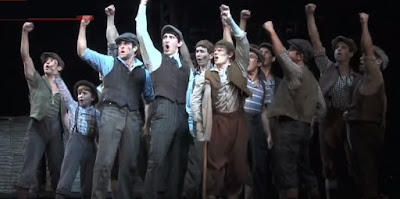
The music for the movie is composed by Alan Menken, who has been nominated for numerous Academy Awards, winning the Best Original Song Oscar for Disney cartoons Little Mermaid and Aladdin.  The movie soundtrack boasted some memorable songs with catchy tunes and lyrics including the group numbers "Carrying the Banner" and "King of New York", and the rousing, anthemic songs "The World Will Know", "Seize the Day" and "Once And For All" that rally the boys to strike.  These wonderful songs are kept for the musical, although some of the lyrics are modified to match the changes to the story, or expanded to make the songs more substantial.  The greatest changes are made to the power ballad "Santa Fe"–Jack's escape song where he dreams of leaving the New York rat race for the open country of New Mexico.  In the movie, Jack sings it after meeting Dave and Les' family and it is a lament for his own lack of family.  Since the entire sequence of meeting the family is eliminated from the musical, the song is moved to become the opening number that Jack sings to his best friend, the gimpy Crutchie, and the entire first half of the song is rewritten to remove references to the family or Jack's lack of one.

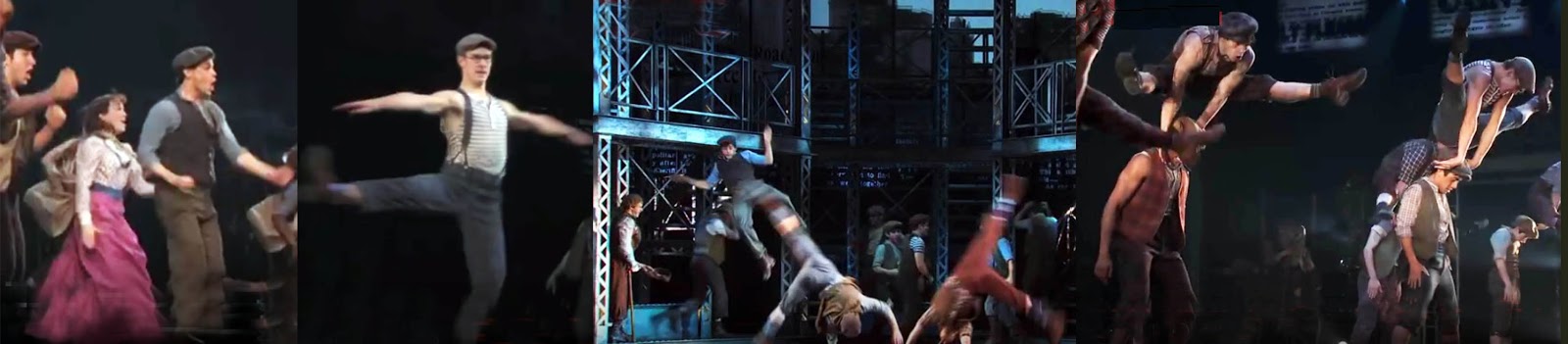
In both the movie and the musical, the highlights involve the large group dance numbers, which is not surprising since the movie's director Kenny Ortega is also a renowned choreographer.  Both versions of Newsies involve many styles of dancing including ballet, jazz, tap, and acrobatic cartwheels, flips and slips.  For the song "Seize the Day", the music and dance style have a distinct Irish Celtic flavour to them.  One interesting adaptation from movie to musical occurs in the dance sequence for "King of New York".  In the movie, one of the newsies simulates a ballet spin by holding onto the slow-moving blades of a ceiling fan while standing on a table.  The equivalent of this in the musical involves a breathtaking, extended pirouette while spinning on a piece of newspaper.

Considering that this is a touring road show, the musical Newsies has some very impressive staging including the use of large, mobile metal grid structures with fire-escape stairs attached to them. The multi-leveled sections are used for scurrying up and down during chase scenes and accentuates the number of newsies on hand during the group numbers.  The use of video adds much clarity and drama to the production, allowing you to better visualize what is happening on the stage.  When Jack sketches a picture of Katherine while trying to woo her, the representation of his portrait is slowly revealed on a large screen in the background, so that you feel like you are looking over his shoulder and watching him draw.   When Katherine is struggling with what to write for her big news article on the newsies strike, the words that she types is shown on the screen, as is the final resulting article.  The headlines of the daily news are broadcasted in large bold letters, and when a photo is taken of the newsies after a victorious protest, that image is displayed after the poof of the camera flash bulb.

The only scene in which the Newsies musical failed to capture the excitement of the movie is unfortunately the climatic finale, where Jack and Katherine's printing of their own newsletter has inspired child labourers across New York to come join them in a massive rally.  While the musical obviously could not add the thousands of extra live bodies like the movie did, they could at least have used video and audio effects to simulate the crowds and generate the necessary exhilarated buzz.  Instead, we had a small group of boys standing behind a gate in the upper right hand corner of the stage, making not much noise at all, and Jack is verbally describing to Pulitizer (and to the audience), the enormous number of children that supposedly had gathered.

Both Kinky Boots and Newsies are feel-good musicals about the little guy triumphing over adversity and both leave you tapping your toes and smiling on the way out of the theatre.  But while I don't remember most of the songs from Kinky Boots, it is the infectious songs from Newsies that I am still humming and singing along to several weeks afterwards.

Tuesday, July 28, 2015

Fringe 2015 - Part 3 and Best of Fringe

The show that seemed to generate the most buzz at this year's Toronto Fringe Festival was "A Man Walks Into A Bar", which uses the telling of the universally common bar joke to provide a subtle yet scathing commentary on the dynamics and power-play struggles of male-female relationships. A woman stands on stage and starts to deliver the classic opening line of the bar joke, when her male companion stops her with the feedback that she is speaking too quickly.  She graciously accepts the advice and starts again, slower.  The man continues to interrupt her, asking for clarifications about the bar, the man in the joke and the waitress that he interacts with, to the point where the joke-teller starts to get a bit annoyed but tries not to show it.  She humours him and agrees to act out the scenario of the joke with him.  At this point, the lines start to blur between the role of the woman telling the joke versus the waitress, and the man listening to the joke versus the man in the joke who walked into the bar, until for all intensive purposes, each pair of roles meld into one.

As the joke proceeds, the relationship between the waitress and her customer goes from jovial and slightly flirty to a more ominous situation where the woman feels increasing uneasy and slightly fearful of the man.  The moral of the play seems to be that in certain male-female interactions, the woman needs to be always on her guard for the possibility that the situation could turn hostile or even violent.  The play is written by a woman and a self-proclaimed feminist.  If the intent was to generalize and indict the male population, then it seems a bit harsh, but there is no doubt that the circumstances conveyed in the play are ones that women could and possibly do encounter regularly.  The punchline of the joke is a red herring, since it soon becomes obvious that the woman is never going to be allowed to finish telling the joke.  This was an interesting play that made you think about it long after you left the theatre.


We found our final show, "She Said Yes", to be a bit lightweight and disappointing.  Dealing with dating in the internet age, it trotted out all the usual tropes in terms of plotline (girl looks for love via online dating, speed dating, etc.) and jokes (actors playing the roles of different stereotypical prospective dates, popping up with different wigs, costumes, accents and personas).  The play did not provide any new insights relative to what we've seen in shows from previous years on the same topic and there was not really enough storyline to make you care about the heroine.  The only thing that slightly peaked my interest was the fact that various suitors were played by identical twin brothers.

After this year's Fringe Festival was over, only one show from the Best of Fringe nominees appealed to us.  We watched the sarcastically witty and biting song-cycle musical called "People Suck", which ran through a series of different scenarios where people are found to be annoying, obnoxious or who otherwise "suck".  The first song was called "Disclaimer", warning of the obscenities and lewd topics to follow, and the next few songs in the play were hilarious.  A number called "Where the Hell is Darwin When You Need Him" listed off a variety of losers including ones who put on makeup or eat while driving, while "Of All The People Who I Hate" targeted abusers of English grammar.  As various skits portrayed annoying personality types at the office in the song "Office Drama", we all nodded knowingly in recognition.  My favourite song, which was reprised a couple of times, was called "The Man They Call The Flake", a man so unreliable that he lets down friends, family and coworkers alike.  The best comedic timing was exhibited by the actress who sang "People Suck ... but not when you want them to", lamenting about not being able to find anyone to perform oral sex on her.  The final few songs tried to get serious and the sudden change in tone felt jarring and out of place.  I didn't really understand what some of these songs were about, but they totally deflated the happy mood generated at the beginning of the show.  I think they should have stuck to the humorous songs, which I really enjoyed.

Monday, July 06, 2015

Fringe 2015 - Part 2

After our first set of shows, I was questioning the wisdom of picking musicals to watch at Fringe, since the sound quality is so often hit and miss, making it difficult to hear  the singing.  Today, after attending the stellar production of the musical Summerland, my faith has been restored and I have been reminded that the exuberant feeling which occurs when you strike gold at Fringe makes it worthwhile to sit through a few duds.  The adage "You can't win if you don't play" comes to mind.
 

The plot of Summerland starts off as a musical version of The Breakfast Club, when eight students ranging from cool kids to nerds are sent to the principal's office for various infractions including cheating on exams, pulling a fire alarm, posting a sex tape on the internet  and bullying a classmate.  Instead of detention, they are sent via bus to a week-long boot camp called Building Our Own Bridges (the acronym BOOB played for a joke) which is meant to rehabilitate them.  Surprisingly, the victimized student is also sent on the excursion as a means to find out why he is always getting picked upon. The camp is a mere plot device to get the kids on the bus, since they never arrive at it.  At a rest stop, the students highjack the bus and go cruising down the highway, leading to a crash.  The staging and choreography of the bus crash is reminiscent of the musical "Ride the Cyclone" which features  a rollercoaster accident.  As a result of the crash, the group is transported to a magical realm called "Summerland", a  Neverland-like refuge for runaways, full of nature and beauty, where the sun always shines and it is always summer.   Here, the students discover truths about themselves and each other, until an incident turns the utopia into a Lord of the Flies scenario of fear, mistrust and anarchy.

Summerland is written by composers Anika Johnson and Barbara Johnston, whose previous musical Blood Ties was featured on an episode of the Sci-Fi hit Orphan Black.  Along with singer/composer Suzy Wilde, they were commissioned to create an original work specifically for the students of Wexford Collegiate School for the Arts.  Perhaps as a way to provide roles for the entire arts program, the cast list is unusually large.  Between the twelve featured roles, most assigned to a principal actor and an understudy, and the huge ensemble, the cast includes over 100 young performers.  The musical was first performed by the Wexford students in 2014.  For Fringe 2015, a new cast was formed by amalgamating Wexford actors with members from three other arts schools, including Etobicoke School for the Arts, Randolph Academy of the Performing Arts, and Sheridan College.

Summerland is by far one of the most professionally polished and well executed musicals that has ever graced the Fringe Festival.  Sitting through it, you felt like you were watching a major Mirvish production.  Everything was top notch, from the beautiful score and songs, to the amazing singing, dancing and acting performances of the young actors, to the elaborate sets and gorgeous costumes, to the staging, sound quality and lighting.  There was even some aerial acrobatics on display when the mythical Summerland first appeared.

In order to accommodate the enormous cast and intricate staging, a new venue has been added to Fringe for the first time—the large auditorium of  Harbord Collegiate Institute.  The production takes advantage of all spare space in the venue to hold the numerous performers, including the large stage, centre and side aisles and upper balcony.  Setting the opening school scenes in an actual high school gave them an added sense of authenticity.  For me, it was extra surreal since Harbord Collegiate was my old high school and the last time I sat in that auditorium was 30 years ago.  Suddenly, the words to our old school fight song came flooding back to me—"Onward Harbord .. On to Victory!"

Every  year,  I consider which play might be good enough to attract the attention of and be swooped up by a professional theatre organization like Mirvish (e.g My Mother's Lesbian Jewish  Wiccan Wedding) or Soulpepper  (e.g. Kim's Convenience).  Summerland definitely qualifies in terms of quality and entertainment but its huge cast and staging would be too unwieldy and expensive to reproduce on a commercial basis.  With some cuts of peripheral cast members and a tightening of the storyline, this show would definitely be good to go.


The running time of the comedy Meet Cute is short at only 45 minutes and yet, the premise is so clever and so well executed that you leave thoroughly satisfied from having watched a good show.  The same scene and exact same dialogue is delivered three times consecutively by the same actors, with the only difference being point of view.  In each case, John and Jane encounter each other while waiting for bus and enter into a conversation with each other.  

In the first scenario, John has engineered the meeting by deliberately letting other buses go by while he waits for Jane to arrive.  As she distractedly sits down on the bench next to him, he places his palm down so that she accidentally sits on it, triggering their interaction.  They make small talk as they wait for the bus and Jane becomes more and more uncomfortable as John encroaches in her personal space and his words seem full of creepy subtext.   The scene ends with Jane calling out for a taxi to get away from John.

In the next scenario, it is Jane who manipulates the meeting and is the aggressor in the conversation.  It was fascinating to watch the exact same dialogue being spoken, but taking on an entire new meaning in this new context.  Occasionally, John and Jane swap lines to make the scenario play properly, but for the most part they carry on the same conversation.  This time, it is John who is made to feel uncomfortable and eventually tries to get away.

The final scenario involves a chance meeting where Jane and John are mutually attracted to each other.  Suddenly the icky come-on lines become awkward, endearing and even romantic.  All that has changed in each case are the mannerisms, facial expressions, body language and the tone of delivery of the words.  This time, the call for a taxi is mutual as the two go off together to get to know each other better.   The playwright Erin Norah Thompson, who also plays Jane, summed it up best in the programme notes when she muses that "the difference between romantic and creepy is consent".

The physicality and comedic timing of the actors have to be perfect in order for this premise to play out properly and the two performers accomplish this in spades.  As an additional visual cue, the bench that John and Jane sit on is skewed towards him in the first scene, then moved to angle towards her in the second scene.  In the final scene where they come as equals, the bench is straightened to be parallel with the stage.   The use of Radiohead's "Creep" is the perfect song choice for the brief interludes between each scene.


By contrast to Meet Cute, the 50 minute long song cycle I'm Right Here felt too short and inconsequential, probably because there was no real plot or story arc.  The series of songs share the common theme of the dehumanizing dangers of the Internet and the need to renew personal contact and interactions.  The songs were pleasant enough with a few containing nuggets of wisdom to take to heart, and the actors all had excellent voices.  But there were not enough of them and we left the show feeling unsatisfied.  The best singer, Lana Carillo, befittingly had the best number.  Belting out "Guess What?  We have a Problem!", she goes on to lament how she can't understand what the kids are saying and that we are losing our grasp of the English language with all the Tweeting and Facebooking.  That she had such a powerhouse voice was amusing when compared to her diminutive stature.  Even in heels, she seemed a good foot shorter than the three other cast members, including the other female lead who wore flats.  I enjoyed what there was of this musical.  I just wish there had been more.

 We originally intended to watch the comedy "A Man Walks Into A Bar" tonight but we did not realize that the Fringe no longer keeps half the tickets for each show to sell at the door one hour before the show.  They actually changed this rule last year, but because we missed the festival, we were not aware of this.  So our intent to use our value pass to purchase two tickets at the door was thwarted when the show sold out the day before.  Luckily we were able to get tickets for another performance of the show, but we will have to rethink how we use our value pass in the future.  Starting this year, you can pay an extra $2 per ticket in conjunction with the value pass make advance ticket purchases for popular shows.  We will keep this in mind for next year.